
Blog
Why we touch our face without realising it

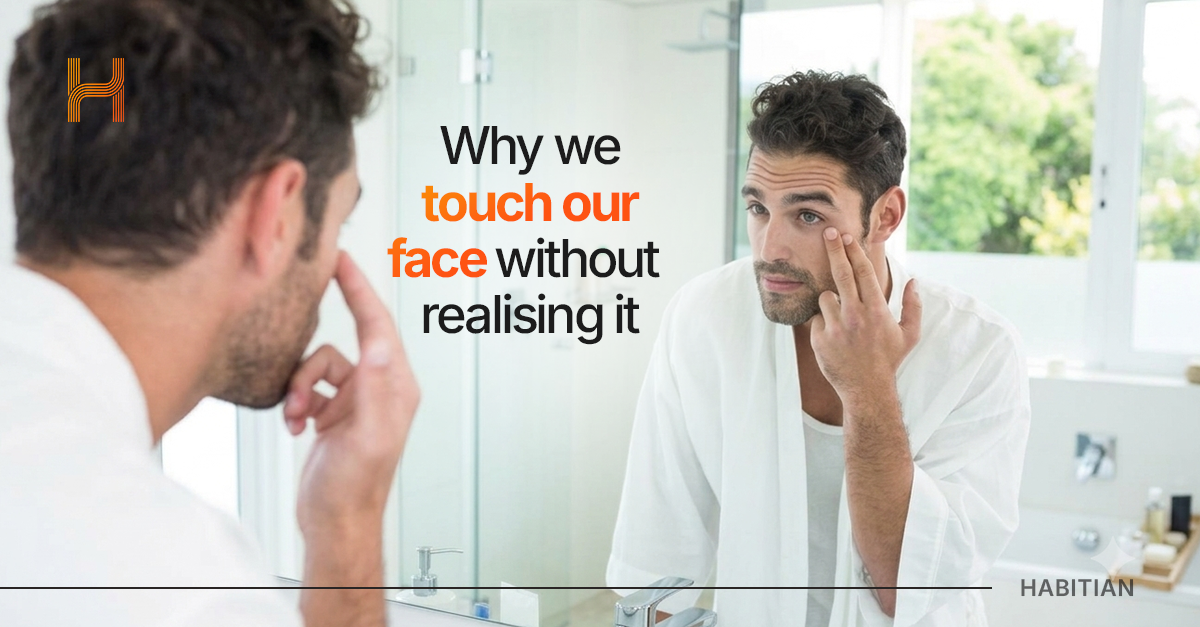
You’ve touched your face at least ten times since you started reading this. You have not noticed a single one of them. If someone had asked you, thirty seconds ago, whether you touch your face often, you’d probably have said not really, and you’d have been entirely wrong. Studies that have bothered to count put the number somewhere between fifteen and twenty times an hour, which works out to roughly 250 times a day, most of it invisible to the person doing it. This everyday face touching is one of those behaviours that happens almost entirely outside your awareness.
Why Is It So Hard to Stop?
The pandemic tried to make everyone stop, briefly, in 2020. It didn’t work, and studying why it didn’t work turned out to be the most interesting part. Even trained health professionals who were paying full attention to their hands couldn’t stop touching their faces. The behaviour is deeper than conscious control. It runs on a track underneath your attention, using idle moments of your day to do something you never decided to do, and you can’t will your way out of it because you were never really in the driving seat to begin with. These automatic habits are often much harder to control than behaviours you consciously choose.
Some of the reasons for this are physical and boring. Faces itch. Noses need scratching. Hair falls in your eyes. Glasses slide down. If your face has a face-shaped inconvenience happening on it, your hand is designed to go and fix it, and it will, without waiting for permission. Fine.
👇 Common Physical Reasons
- Itchy skin
- A nose that needs scratching
- Hair falling into your eyes
- Glasses sliding down

The Emotional Side of Face Touching
The more interesting reasons are emotional. Most of the face-touching you do throughout the day has nothing to do with an itch. It’s self-soothing. Researchers have a name for this class of behaviour, spontaneous facial self-touch, and it correlates strongly with thinking, remembering, transitioning between tasks, feeling nervous, feeling embarrassed, and being confronted with something you don’t want to deal with. Your hand goes to your face because something in your nervous system needs comforting, and your face is the nearest thing your hand has ever known. This kind of self-soothing can happen without you consciously deciding to seek comfort. It’s soothing yourself the way a small child holds a soft toy, except the toy is your own cheekbone.
You touch your face more when you’re on a difficult call. You touch your face when you’re about to say something you’re not sure about. You touch your face when you’re reading an email that stresses you out. You touch your face when a memory shows up that you weren’t expecting. These small touches are your nervous system stepping in to help, without asking you first, using the equipment closest to hand.
Situations That Can Trigger Face Touching
- During a difficult phone call
- When feeling nervous or embarrassed
- While reading a stressful email
- When thinking deeply or remembering something
- When transitioning between tasks
What Does This Mean for Your Skin?
Which means, incidentally, that all of this has real implications for your skin. Every one of those 250 daily touches deposits whatever your hand is currently carrying onto your face. Which is, on any given day, a truly impressive list of things. Phone screen. Doorknob. Someone else’s keyboard. The lift button. The steering wheel. A menu at a restaurant. Your own hair. The strap of your bag. All of it making its way onto your cheeks, your jaw, your forehead, and the T-zone that mysteriously keeps breaking out even though you switched to a new cleanser last month. For skin health, the simple act of keeping your hands clean can matter more than trying to eliminate every touch.
Everyday Things Your Hands Touch
- Phone screens
- Doorknobs and lift buttons
- Keyboards and steering wheels
- Restaurant menus
- Hair and bag straps

What Can You Do Instead?
Most skincare advice will tell you to stop touching your face. Most skincare advice is wrong about this, because stopping is not a thing you can meaningfully do. The behaviour is too automatic. The nervous system is too committed. What you can do, instead, is wash your hands more, especially when you’re about to sit down at your desk or start scrolling on your phone, because that is when the touching begins in earnest. Clean hands and unwashed hands both find your face at roughly the same rate. Only one of them is doing damage on the way there.
Simple Habits to Follow
- Wash your hands regularly.
- Clean your hands before sitting down at your desk.
- Wash your hands before scrolling on your phone.
- Focus on keeping your hands clean rather than trying to eliminate every touch.
Face Touching as an Anxiety Signal
There’s also a useful thing to notice, once you know about this, which is that face-touching is a decent low-cost anxiety signal for yourself. In that sense, face touching can become one of the small anxiety habits worth noticing rather than judging. If you catch yourself doing it more than usual on a particular day, something is going on. You might not know what yet. You might figure it out by evening. But the hand tends to know before the head does, and it will start helping before you’ve registered that you need any help.
💚 Notice, Don’t Judge
The next time you notice your hand on your face, don’t slap it away, and don’t feel bad about it. Just notice it. Notice what you were thinking about. Notice what you were feeling. Notice whether you’ve eaten in the last four hours. It’s a small piece of information, delivered by a part of your body that’s been paying more attention to you than you’ve been paying to it. And then, if it seems relevant, wash your hands.