
Blog
What Your First 20 Minutes After Waking Say About The Rest of Your Day

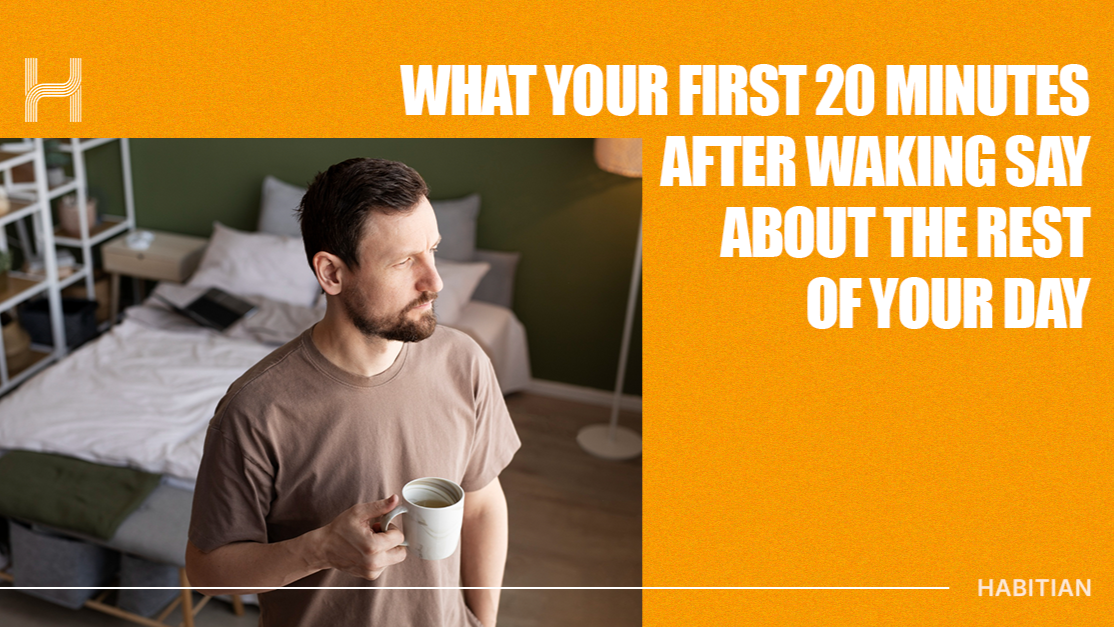
There’s a small window in the morning, somewhere between opening your eyes and properly being awake, where the day hasn’t decided what it’s going to be yet,🌤️ and most people spend that window on their phone.
It seems harmless enough. A scroll, a few messages, a quick check on who did what while you were asleep, all of it taking maybe ten minutes and feeling like a perfectly reasonable way to ease into being a person again. Nobody describes it as a habit. It just sort of happens, in the way breathing happens, except your thumb is involved. 👍📲.
The trouble is that those twenty minutes are doing real work whether you notice them or not, 🧠 because sleep is the longest stretch of nothing the brain gets all day, and when you wake up the body is still quietly rebalancing itself.

Cortisol is rising, blood sugar is shifting, the nervous system is making the slow journey from rest into action, and all of that is happening on a gentle curve rather than as a switch you can flip. The first twenty minutes are a kind of onboarding for the day, a stretch of time where the body works out what sort of day this is going to be, and the way you spend that window largely answers the question on its behalf.
- Spend it absorbing
- eight news headlines,
- four messages,
- two work fires,
- a friend’s holiday photos,🌴 and
- a stranger’s strongly held opinion about a film 🎬 you haven’t seen,
and the body learns very quickly that today is going to be reactive. The nervous system catches up. By the time you’re standing in the kitchen waiting for the kettle ☕, you’re already a little behind, already a little anxious, already in response mode, and the day is technically not yet an hour old.⏰
You’ve trained yourself to chase before you’ve even brushed your teeth, which seems unfair on you and also on the day.
The fix here isn’t a wellness routine,🧘♀️ and there is no version of this article that ends with a recommendation to do twenty minutes of journaling before sunrise.
People who’ve started feeling better in the mornings tend to have changed something almost embarrassingly small, which is that they delayed picking up the phone. Twenty minutes, sometimes thirty. Long enough for the body to do what it was always going to do anyway, which is wake up at its own pace.
- They drink some water.
- They open a window.
- They stand somewhere with light.
- They move slowly between rooms in the kind of pyjamas that wouldn’t survive a video call.
None of it is impressive, none of it photographs particularly well,📵 and none of it would do well as a piece of content. It does, however, change how the rest of the day feels.

The science underneath all of this is genuinely interesting 🔬 and also oversold, depending on which corner of the internet you’re standing in.
- Morning light exposure does help regulate the circadian system. 🌞
- Hydration after seven or eight hours without water is useful. 💧
- A bit of movement helps clear that thick residual sleep inertia faster. 🚶♂️
All of that holds up.
The bigger and harder thing to measure is the shift in baseline, which is just that the day feels different when the first input was something the body asked for rather than something an algorithm served you while you were still horizontal. 📲➡️🧍
There’s a behaviour science point worth landing on here, because it explains why the morning phone habit is so unusually sticky, 🧠🔁and it isn’t a discipline issue.
The brain forms habits around context cues, and the cue of waking up is tightly bound to the reward of the phone, 📱✨which offers information, connection, and a small but real distraction from being a person at 7am.
You don’t decide to scroll.
You wake up, and your hand finds the phone before the thought has even finished forming, which is impressive in a slightly disturbing way. 🤏📲
Trying to muscle through that with willpower is mostly a losing battle, because the cue stays exactly where it was and the reward is still extremely available.
What works better is changing the cue itself, in ways that are almost annoyingly basic.
- Charging the phone in another room.
- Leaving a glass of water by the bed instead.
- Cracking the curtains open the night before so that light is the first thing that lands on you.
Behavioural research has been saying versions of this for years now, 📚 and it usually comes down to the same idea, which is that design tends to beat willpower, and the morning routine that actually lasts is the one where the easiest available option also happens to be the one you wanted.

None of this is meant as a prescription, by the way, and there’s no one correct way to start a day. Some people genuinely do need to check their phone first thing because of work, or family, or because they live in a different time zone 🌍 from someone they love. The point is just that those twenty minutes are doing something either way, and most of us have quietly outsourced them to an algorithm without ever really agreeing to it.
A morning routine doesn’t have to be elaborate to count, and it almost never benefits from being elaborate in the first place. The smallest version of it is just paying attention to what the first input of the day actually is. If the first thing the brain processes most days is a notification, the day will feel like it began as a response to something.
If the first thing is light☀️ , water💧, the sound of the kettle ☕, your own thoughts arriving in their own slightly messy order,🌼 the day starts somewhere closer to neutral, and neutral turns out to be a wildly underrated way to begin.
Most people aren’t trying to engineer a transcendent morning. 🌅They’re trying not to feel slightly behind by 9am. The benefit of consistent morning habits, done over weeks rather than days, 📆 is that they remove the small daily tax that comes from starting every morning in reactive mode.
You may not notice the change after a week.
After a month, the rest of the day is quietly easier, and you stop being able to remember why it ever felt heavy in the first place.

The first twenty minutes don’t decide everything. They do decide what kind of day the body thinks it’s in, and the body, as it turns out, usually believes itself.