
Blog
The Silent Damage of Optimising Every Part of Your Life

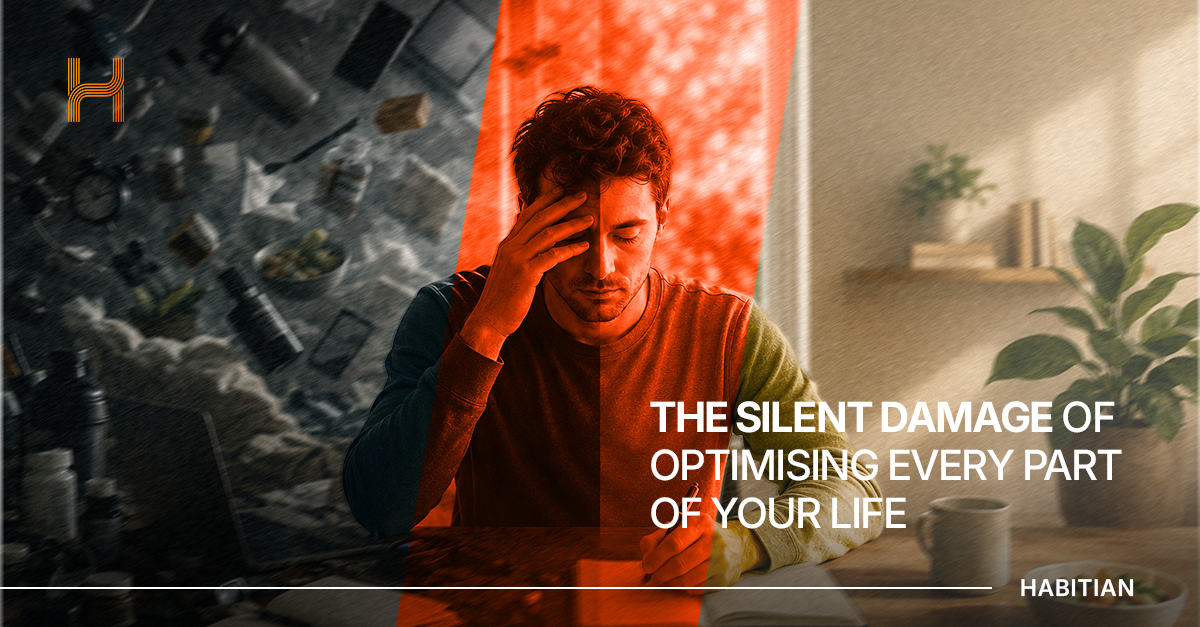
There’s a specific kind of tired that doesn’t come from working too hard. It comes from spending three years trying to improve everything about your life simultaneously.
-
Your sleep.
-
Your skin.
-
Your gut.
-
Your morning.
-
Your evening.
-
Your inbox.
-
Your screen time.
-
Your breathing.
-
Your posture.
-
Your supplement stack.
-
Your relationships with people you allegedly want to grow with.
The list keeps expanding, and underneath all of it, you’ve started to feel slightly worse, even though, on paper, everything is being optimised.
This is the modern condition that nobody quite knows what to call yet, and it doesn’t show up on any blood test. You are not lazy. You are not failing at your projects. You are succeeding at all of them, in a small, exhausted way, and you’re somehow more anxious than you were before you started any of this.
The wellness industry has handed you a hundred dials to turn, and you’ve turned all of them, and the dashboard now reads:
“Slightly worse, but more informed.”
Optimisation Has No Finish Line
Optimising is a verb that does not understand the concept of an endpoint.
Once you’ve started optimising your morning, the same logic naturally extends to:
-
Your evening
-
Your weekends
-
Your meals
-
Your hobbies
-
Your friendships
There is no natural stopping point, because the entire framework is built on the assumption that things could always be slightly better.
You wake up at 6.30am, and a podcast informs you that 5.45 is when the real winners get up. You drink your water, and an Instagram post explains that you should be adding electrolytes. You take a walk, and your watch reports back that you weren’t in zone 2 for long enough.
When Living Turns Into Tracking
By the time you’ve finished the optimised version of your day, every hour is full of small projects, none of which feel like rest.
You’re no longer:
-
🍽️ Eating lunch — you’re “having your protein”
-
🚶 Going for a walk — you’re “hitting your steps”
-
😴 Resting — you’re “recovering”
The activities that used to be ordinary are now performances, and the audience is a wearable that judges you all day.
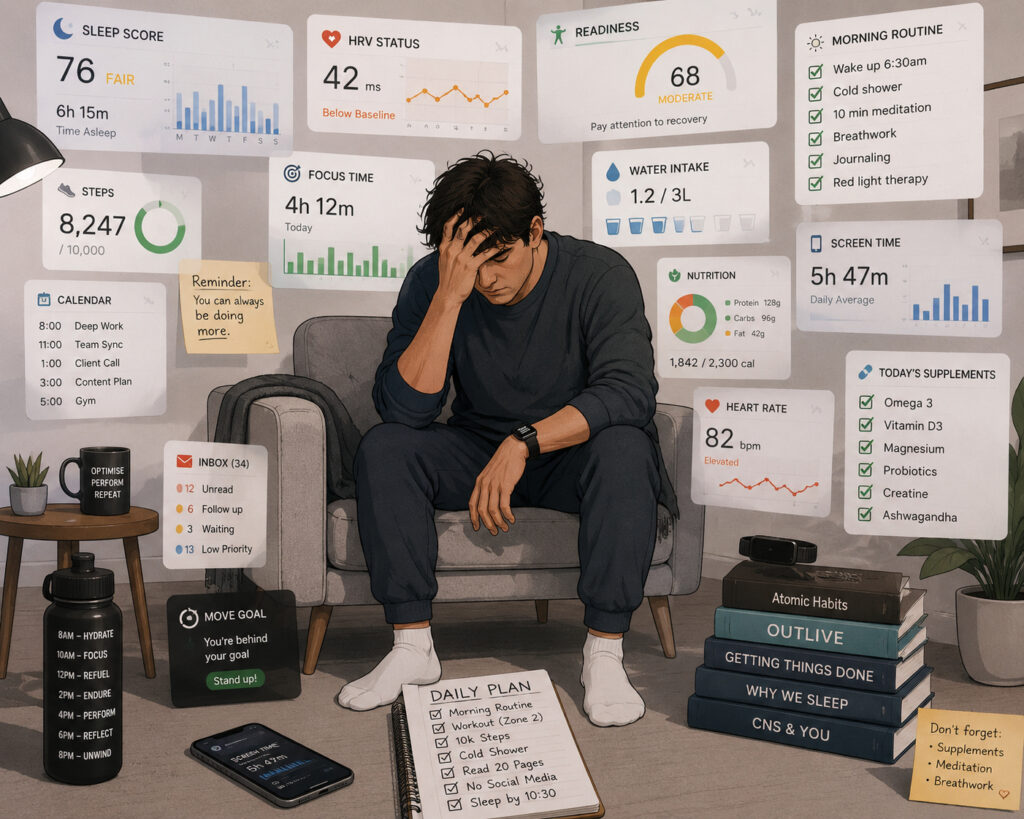
The Hidden Cost of Constant Improvement
There’s a real cost to this, and it’s significantly harder to see than burnout, because it dresses up as discipline.
The damage often looks like:
-
A constant feeling that you’re falling behind
-
A slightly elevated heart rate
-
Endless self-monitoring
-
A background hum of inadequacy
-
Tiredness you can’t fully explain
You can spend years optimising your routines and still arrive at the same place: exhausted.
Consistency vs Optimisation
The thing that gets lost in all of this is consistency, the deeply unglamorous cousin of optimisation that nobody is selling courses about.
Consistency says:
-
Do the same medium-effort thing
-
Keep showing up
-
Let habits take root
-
Trust repetition
Optimisation says:
-
Keep tweaking
-
Keep improving
-
Keep changing
-
Keep searching for better
From a distance, these two impulses look similar.
They are not.
Consistency wants you to keep doing the thing.
Optimisation wants you to keep changing the thing.
And changing the thing repeatedly, based on last week’s podcast, is precisely how most routines eventually fall apart.
Why Slow Productivity Is Making a Comeback
Slow productivity has been making a comeback for a reason.
People are exhausted.
And the things that ended up helping them weren’t the optimised versions.
They were the basic versions:
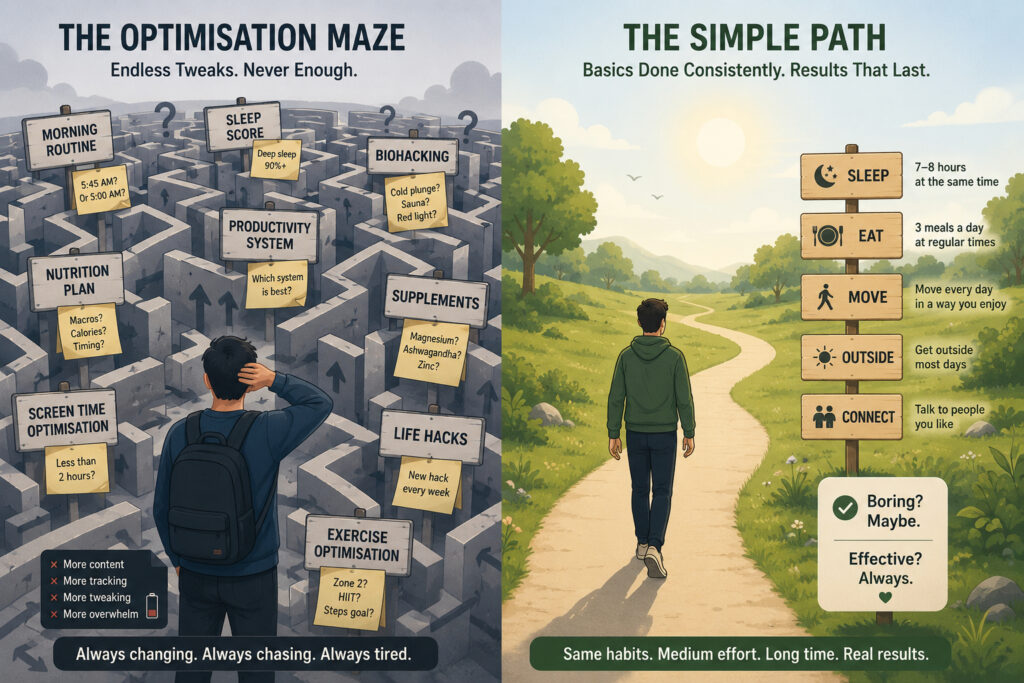
✅ Sleep at the same time
✅ Eat at the same time
✅ Move during the day
✅ Stop checking your phone in bed
That’s roughly the entire syllabus.
It just doesn’t fit neatly into a slide deck.
The Mental Tax Nobody Talks About
Every optimisation requires a small amount of decision-making energy to install and maintain.
Stack enough of them together, and your mind effectively becomes a dashboard.
You end up constantly asking:
-
Did I get enough protein?
-
Did I hit my steps?
-
Did I sleep deeply enough?
-
Did I take the right supplements?
-
Did I optimise my morning?
You can’t fully relax because there’s always one more setting to adjust.
The day stops feeling like a day and starts feeling like a system you’re running on yourself.
Check The Foundations First
Before adding the next optimisation, a more useful question is whether the basic version is even in place yet
- Are you sleeping seven hours?
- Are you eating three meals at roughly the same times?
- Are you moving during the day?
- Are you outside at some point most days?
- Are you talking to humans you like?
If any of these aren’t happening, optimising your supplement stack is genuinely pointless.
It’s like polishing the silver in a house that hasn’t paid the electricity bill.
The Version of Life That Actually Lasts
The version of life that works long-term is the boring one.
Most of the basics are in place at a slightly underwhelming level.
-
Nothing has been optimised to its absolute best.
-
Nothing photographs particularly well. You don’t have a content-worthy morning.
You don’t have an aesthetic evening.
You just have a day, made up of a few solid habits, done at a medium effort, repeated for a long time. The reward is that you stop feeling like every part of your life is a project, and most days start feeling like days, which used to be enough, and could be enough again.