
Blog
Why you can tell how a person is doing by looking at their bathroom

You can tell a lot about how someone is doing by looking at their bathroom, and almost none of it comes from what’s on display. It’s the stuff that’s been abandoned that tells the real story. The half-used serum from a phase they’ve since moved past. The face wash that’s been almost empty for two months but hasn’t been thrown out. The floss that’s been sitting in the exact same position, judging them, since March. 🧴
- The half-used serum.
- The almost-empty face wash.
- The floss that hasn’t moved since March.
A person’s bathroom is one of the most honest rooms in their house, because it’s the one they don’t stage. Guests don’t really see it. There’s no aesthetic pressure to make it look a particular way. Whatever’s happening on those shelves is happening for an audience of one, which means it’s roughly the truest snapshot of how that person is actually living right now. 🪞
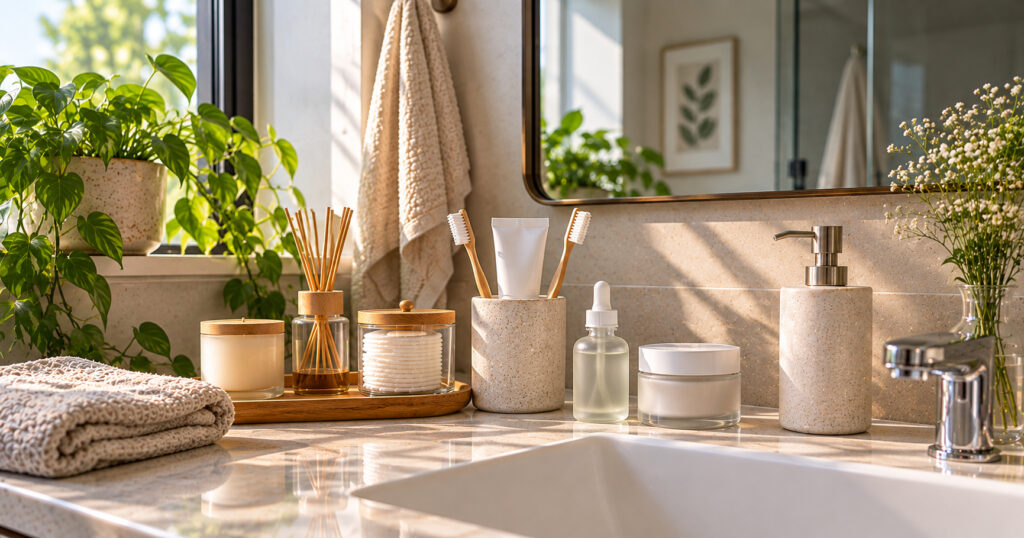
You can tell if someone is in a good phase because their bathroom is boring. Three or four things they use, sitting where they belong, all of them roughly full. Everything else has been used up or thrown out. There’s no ambition on the shelf. There’s no aspirational purchase from six months ago waiting to be justified. It’s calm, because they’re calm, and their skincare is currently keeping pace with their actual life instead of the life they were briefly hoping to have.
- Three or four things they use.
- Everything sitting where it belongs.
- Everything roughly full.
- Everything else used up or thrown out.
You can also tell when someone is going through it, and it usually doesn’t look how you’d expect. The bathroom of someone who’s struggling isn’t dirty. That’s a myth. It’s often the opposite. It’s full. Every category of product is represented, sometimes twice. There’s a full shelf of things that were supposed to fix something and didn’t. There are supplements from three different phases. There’s an unopened box of a very expensive cream someone recommended in December. Nothing has been thrown out because throwing things out requires deciding whether to give up on them, and deciding anything at all takes energy this person doesn’t currently have.

The bathroom is where the gap between the person you want to be and the person you currently are gets stored, physically, in bottles. The abandoned product you bought when you decided you were going to have Sunday self-care nights. The retinol you started three times and stopped. The mouthwash that was supposed to be part of a whole new dental phase. Each one was a promise, and each one is now furniture. 🧴
- The face mask you bought when you decided you were going to have Sunday self-care nights.
- The retinol you started three times and stopped.
- The mouthwash that was supposed to be part of a whole new dental phase.
There’s something interesting about the fact that nobody talks about this, because everyone with a bathroom knows it’s true. You can walk into your own bathroom at any moment and read your life off the shelves. The days you’re on top of things are visible in what’s tidy. The weeks you’ve been overwhelmed are visible in what’s been abandoned. The years you were going through something huge are visible in how much you bought and how little you used. 🪞
This is also why bathrooms are one of the most useful places to build habits, and one of the worst. They’re useful because the room itself is a fixed cue. You go there every morning and every night, no exceptions. Any routine you can attach to a bathroom trip is going to have a built-in reminder. But they’re also terrible, because the room is full of products that are already reminding you of things you were supposed to be doing. Every failed habit is on the shelf. The bathroom is where the guilt lives, and guilt is a spectacularly bad motivator.
- The room itself is a fixed cue.
- You go there every morning and every night, no exceptions.
- Any routine you can attach to a bathroom trip is going to have a built-in reminder.
- Every failed habit is on the shelf.
What actually works is going in the opposite direction of what most people do, which is buying more things when they feel like their routine is falling apart. The bathroom of someone who’s doing well doesn’t have more products in it. It has fewer. They’ve thrown out the aspirational ones. They’ve admitted, out loud or otherwise, that they were never going to use the sheet masks. They’ve picked three or four things that actually work for them and made peace with the fact that this is the routine, not a phase they’ll upgrade from later.
- They’ve thrown out the aspirational ones.
- They’ve admitted, out loud or otherwise, that they were never going to use the sheet masks.
- They’ve picked three or four things that actually work for them.
- They’ve made peace with the fact that this is the routine.
The next time your bathroom starts to feel cluttered, treat it as a small piece of information. Not about your organisational skills, but about what’s been happening in your head lately. Then, without making a project of it, throw out one thing that no longer belongs to the person you actually are. That’s the whole habit. That’s the whole practice. The bathroom will tell you when you’re back on track, and it usually won’t need many products to do it.
- Treat it as a small piece of information.
- Throw out one thing that no longer belongs to the person you actually are.
- That’s the whole habit.
- That’s the whole practice.