
Blog
In Defence of The Mediocre Routine

Nobody’s routine is aspirational, and yours doesn’t have to be either.
The reason routines fail, more than anything else, is that people design them for a version of themselves that only exists on a good day.
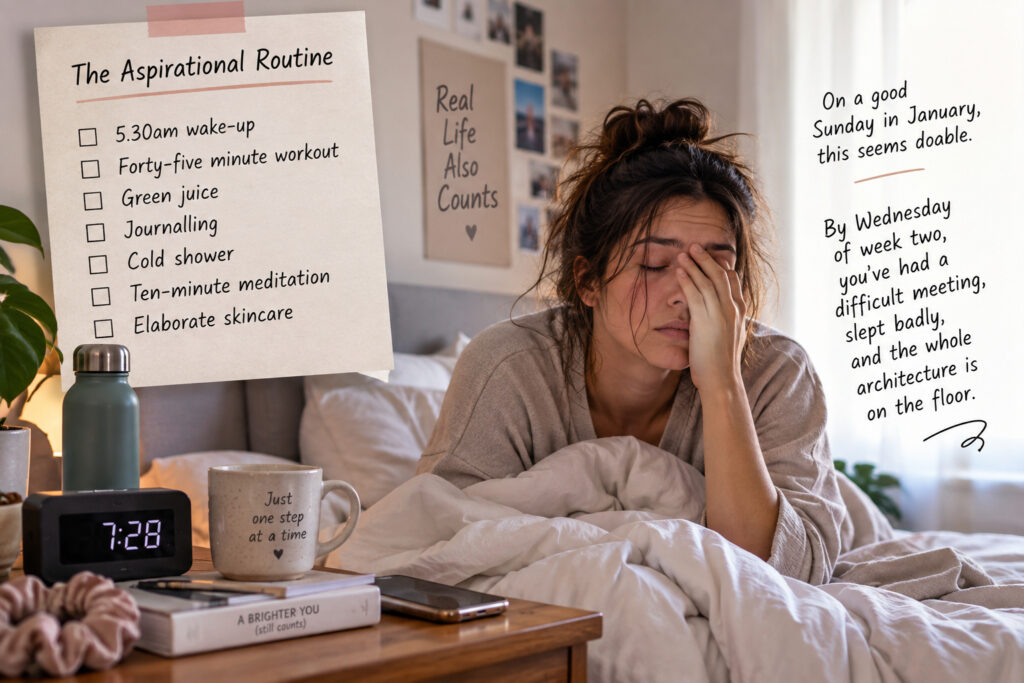
- The 5.30am wake-up.
- The forty-five minute workout.
- The green juice.
- The journalling.
- The cold shower.
- The ten-minute meditation.
- The elaborate skincare.
On a good Sunday in January, this seems doable. By Wednesday of week two, you’ve had a difficult meeting, slept badly, and the whole architecture is on the floor. 🫠
What survives is the mediocre routine. The one you designed for a bad day and then just kept doing.
- Wake up at a reasonable hour.
- Drink some water.
- Move a little.
- Eat something.
- Wash your face.
- Sleep at a reasonable hour.
That’s it.
There’s nothing to photograph. There’s no productivity guru selling a course on it. It won’t transform your life in ninety days.
But it will still be there in five years, which is more than can be said for almost any routine that requires you to be at your best. 🌱
The problem with aspirational routines
The problem with aspirational routines is that they’re built around your best self, and your best self-shows up maybe three days a week.
The other four days, you’re tired, distracted, low on time, low on energy, dealing with something at work, or just not particularly inspired.
A routine built for your best self will collapse on those four days, which means it collapses most of the time, which means it’s not really a routine.
It’s just a wish list you get to feel bad about. 😮💨
A routine for the four days, not the three
A mediocre routine is designed for the four days, not the three.
It’s built for the version of you who woke up an hour later than planned, has a headache, hasn’t drunk enough water, and needs to be at a meeting in ninety minutes.
That version of you can still:
- wash your face,
- brush your teeth,
- put on sunscreen,
- and eat breakfast.
She can’t do a forty-five minute workout, journal, meditate, and cold-plunge, and expecting her to is how the whole thing falls apart.
🏙️ Routines that fit real lives
There’s a slightly uncomfortable idea inside this, which is that a lot of the routines being sold to us right now are designed for people whose lives look nothing like ours.
The 5am routine only really works for people who don’t have small children, don’t work late, and don’t live in cities where their commute is unpredictable. 🚇
The elaborate self-care evening only works for people whose evenings actually belong to them.
Most of us are not those people.
Trying to live like we are is a very good way to feel like you’re always behind. 😵💫
⏳ The mediocre routine and time
The mediocre routine also has a much better relationship with time.
- It doesn’t take much.
- It doesn’t require you to reorganise your life around it.
- It can be done in twenty minutes total, on both ends of the day, without effort.
Which means it can survive travel, illness, breakups, deadlines, and all the other things that would normally derail a proper routine. 🧳
It survives because it isn’t asking much.
It isn’t asking much because you built it to survive. 💛

🤍 The relationship with yourself
There’s also a psychological point worth making.
Every time you don’t do the routine you promised yourself, you take a small hit to your self-trust.
Do this enough times and you stop believing yourself when you say you’re going to do things, which is a much worse position to be in than just having no routine at all.
A mediocre routine you actually keep is better for your relationship with yourself than an ambitious routine you keep failing at.
This is not a productivity insight.
It’s a mental health insight, dressed up as one. 🫶
The secret is that there is no secret
The people with the most consistent routines are almost always the ones with the least impressive ones.
Their morning is boring.
Their evening is boring.
There’s no protocol.
There’s no stack.
They just do a few basic things, most days, without making a production of it.
When you ask them what their secret is, they’ll shrug, because to them there isn’t one.
They just picked a version of the routine they could actually keep, and then they kept it for a decade. 🕰️
Design for the person you actually are
The next time you’re tempted to design a new routine, resist the urge to design for the person you’d like to be.
Design for the person you actually are, on a Wednesday, at 6.45am, mildly hungover, running late.
If the routine still works for her, it will work for the rest of you.
That’s the whole trick.
The mediocre routine is not a compromise. It’s the point.