
Blog
We are the first generation to be marketed to about our own sleep

👵 Your grandmother slept. She didn’t have opinions about it. She didn’t track it. She didn’t wear a ring on her finger that would tell her, in the morning, how her sleep had gone. She just went to bed at roughly the same time every night, woke up at roughly the same time every morning, and got on with things.
😄 If you’d asked her about her sleep score, she’d have looked at you like you’d asked her about her cricket average.
We are the first generation to be sold sleep.
We are the first generation to be sold sleep. Actual sleep. The thing everyone has always done, for free, since the dawn of being a human, has become a category.
There are:
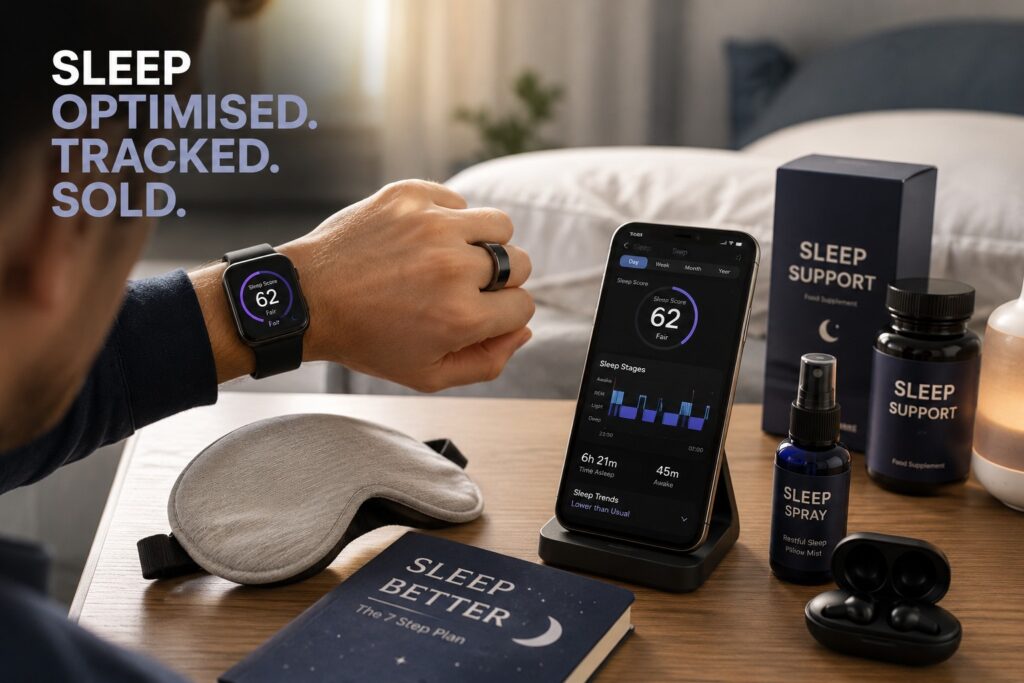
- sleep supplements
- sleep coaches
- sleep apps
- sleep trackers
- sleep maskssleep sprays
- sleep sound machines
- sleep-optimising mattresses
- and a growing number of podcasts explaining why you’re not sleeping properly.
All of this is roughly a decade old. Before that, sleep was just sleep.
It’s worth pausing on how strange this is.
Sleep has always been the most reliable free product on earth. Nobody had to sell it because everyone was already doing it.
Something has shifted in the last ten years, and it’s not that people started sleeping worse, even though that’s the story the industry needs to tell.
👉 It’s that a category of people figured out how to make you feel anxious about a bodily function you’d never really thought about, and then sell you the fix.
💧 It’s the same playbook that turned water into a wellness category, but applied to something even more universal.
The trick is genuinely clever.
First, you convince people that their sleep is bad, or could be better, or is definitely not what it should be.
Then:
- 📊 You sell them the equipment to measure it, which will confirm that their sleep is, indeed, not what it should be.
- 🛍️ Then you sell them the products to fix it.
- 🔄 Then, when the products don’t fix it, because sleep isn’t really a product problem, you sell them more products.
It’s the same playbook that turned water into a wellness category, but applied to something even more universal.
The sleep tracker is the heart of the whole thing.
Once you start measuring your sleep, you can’t stop, because the number becomes the thing you’re chasing.
😌 You wake up feeling fine, check the ring, and discover you got a 62.
➡️ Now you feel worse.
😵 Or you wake up feeling groggy, check the ring, and see an 85, and now you’re confused about your own body, because the ring has told you something different from what you’re feeling.
Either way, you’ve handed over your own sense of how you slept to a small device that decided for you.
Actual sleep researchers…
Actual sleep researchers, the ones doing peer-reviewed work rather than selling products, will tell you that this obsession has created a genuine problem, which now has a name.
🧠 Orthosomnia.
It’s when the pursuit of perfect sleep, tracked and optimised and scored, actually makes your sleep worse.
😰 The anxiety about sleeping well keeps you awake.
🔄 The device is winning by producing the problem it exists to solve.
None of this means sleep doesn’t matter.
None of this means sleep doesn’t matter. Sleep matters a lot.
If you’re genuinely struggling to sleep, please talk to a doctor.
If you have sleep apnoea or insomnia, get it treated.
The point isn’t that the science is fake.
👉 The point is that most people didn’t have a sleep problem until the industry needed them to have one.
🌙 The things that actually help sleep…
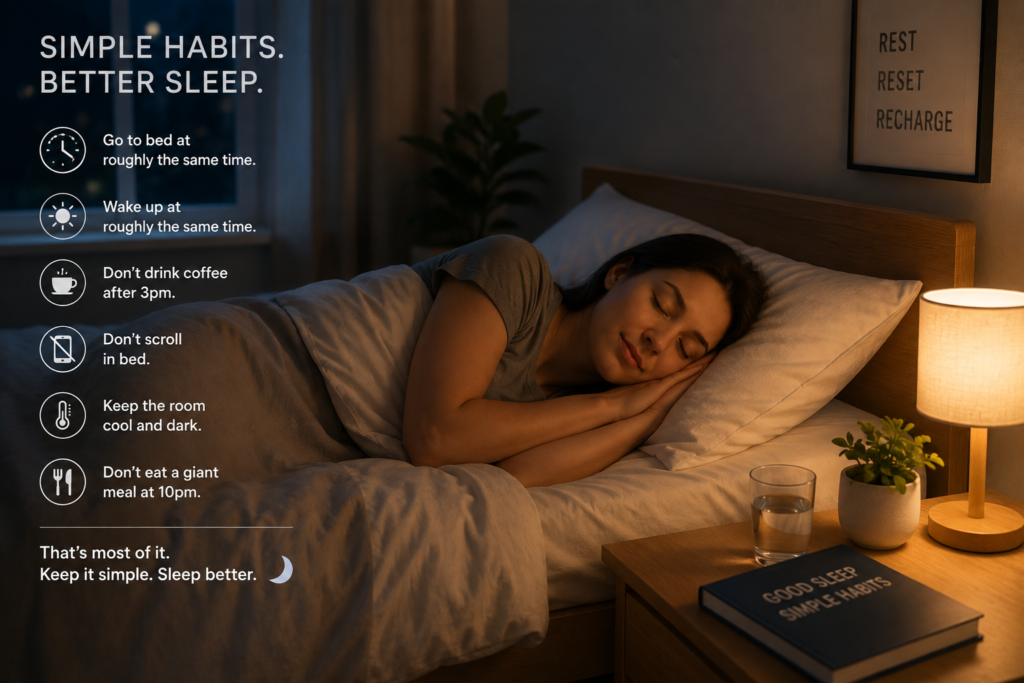
The things that actually help sleep, backed by decades of research from long before there was money to be made from it, are famously boring.
- 🕐 Go to bed at roughly the same time.
- 🌅 Wake up at roughly the same time.
- ☕ Don’t drink coffee after 3pm.
- 📵 Don’t scroll in bed.
- ❄️ Keep the room cool and dark.
- 🍽️ Don’t eat a giant meal at 10pm.
That’s most of it.
None of it requires a subscription.
None of it will make anyone rich, which is exactly why nobody is running ads for it.
The next time you find yourself considering…
The next time you find yourself considering a sleep tracker, or a magnesium spray, or a weighted blanket, or a very expensive mattress, ask yourself an uncomfortable question.
🤔 Were you sleeping badly before you started thinking about sleep this much?
Or did the thinking come first, and the bad sleep follow?
For a lot of people, the answer is the second one, and the treatment is just going to bed and not thinking about it, which is exactly what your grandmother did, for free, for eighty years.