
Blog
The Lost Art of The Boring Evening

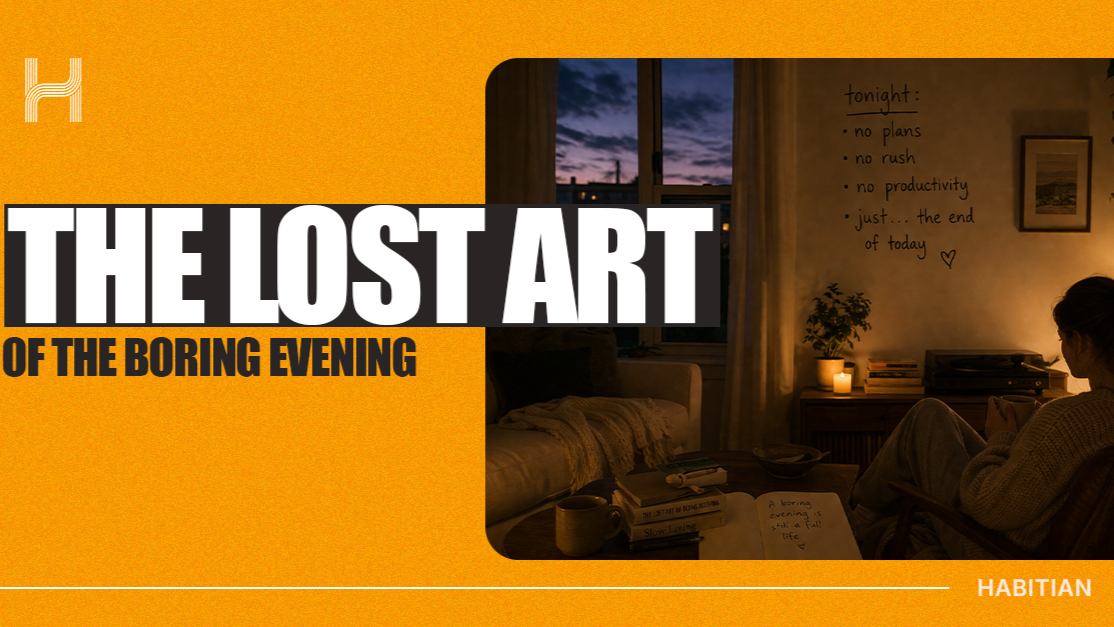
Somewhere along the way, evenings stopped being allowed to be boring, which is a strange loss to grieve, because nobody asked for the change and nobody quite remembers when it happened.
Every hour after work has become an opportunity for something.
- To exercise,
- To socialise,
- To learn a language,
- To side-hustle,
- To optimise sleep,
- To do laundry mindfully,
- To catch up on a podcast about catching up on podcasts.
The default state of a Tuesday night is no longer nothing in particular,which used to be a perfectly respectable way for a Tuesday to go. It’s now a slot to be filled, ideally with something that produces a result by morning.
This is exhausting in a way that’s surprisingly hard to name out loud, because none of the individual things are actually bad.
- A run is good.
- A class is good.
- Catching up with a friend is reliably one of the better ways to spend two hours.
The trouble is the cumulative effect of evenings that have lost the option of being unimportant, evenings where it’s no longer socially acceptable to do absolutely nothing of consequence and call it a Wednesday.

The boring evening is a quiet casualty of all this, and it’s worth being precise about which kind of boring evening we’re talking about.
There’s a curated version of slow living that gets photographed at 7pm with
- a single candle and 🕯️
- a cup of something warm and ☕
- an open book that no one is actually reading, and that isn’t this. 📖
The boring evening that’s been lost is the genuine one. Dinner that wasn’t an event.
A long, formless stretch of time where nothing was being achieved and absolutely nothing was being documented, just the sound of a house at the end of a day, doing very little, for a couple of hours, on purpose.
These evenings used to be where most of life happened, in the small unfilmed way that life often does.
- Reading without finishing the book.
- A conversation that started about something small and gently drifted somewhere else.
- Watching one thing properly, instead of three things at once on three different screens.
- The dishes done slowly because there was no real reason to do them fast.
The body, finally, given permission to stop performing competence at anything for a while.

Boredom turns out to be the mode the nervous system has actually been begging for.
it’s the only state in which the brain stops trying to
- produce,
- respond, or
- perform,
…..and instead starts processing the day it just had.
There’s a reason ideas show up in the shower 🚿so often, and it isn’t that the shower is somehow magical.
It’s that the shower is one of the last places left where most people aren’t doing anything else, which is now a shockingly rare condition for the human brain to find itself in.
A boring evening, done consistently across a few weeks, is one of the most underrated forms of recovery there is.
It is genuinely useless in the productivity sense. There’s
- no metric for it,
- no app that tracks it,
- no way to graph it on a Sunday and feel pleased with yourself.
Which is probably why it’s been silently written out of how we think about a good day, because the things that don’t measure tend to get erased.
There’s a specific kind of evening that almost everyone has had recently, and immediately recognises when it’s described.
- The one where the plans got cancelled.
- The one where the wifi went out for two hours.
- The one that started with vague disappointment and ended, surprisingly, as one of the better evenings of the month, the kind you actually remember.
The reason that evening landed so well wasn’t that it was special or scenic or photogenic.

It was just that, for a few hours, nothing was being asked of you, and the body remembered what that felt like, the way it might remember a song from when you were nine.
The case for protecting boredom in the evening isn’t really a romantic one, and it doesn’t need to be. It’s more structural.
Modern life produces a great deal of input and offers very few places to digest any of it.
The body needs unscheduled time the way it needs sleep, and for most adults the only unscheduled time still on offer is whatever’s left of the evening.
If the evening is also full of things, there’s nowhere left for the day to land, and the day starts compounding into the next one in a way that eventually shows up as exhaustion you can’t quite explain.
Reducing screen time gets a lot of airtime as the answer to all of this, and it’s a useful start, but the real shift isn’t about screens or no-screens. It’s about pace.
- Watching a film slowly with no second screen counts. 🎬
- Cooking something simple and eating it without a podcast counts. 🍳
- Sitting on the floor doing absolutely nothing in particular while a song plays counts, embarrassingly so. 🎵
The format isn’t really the point. The pace is.
Slow evenings are also, almost by accident, where most of the smaller habits actually live and survive.
- The skincare routine that gets done in two minutes because the bathroom is calm.
- The water that gets drunk because there’s time to drink it.
- The book that gets read for ten minutes before sleep because the phone has been put somewhere else for once.
Habits don’t really survive in a packed evening, no matter how good the intention. They settle into the gaps, which means you have to leave some gaps.
None of this requires a new system, which is a relief, because the last thing anyone needs is another routine to fail at by Thursday. It mostly requires deciding, on most weeknights,
- to do less.
- Not nothing.
- Less.
- One thing rather than three.
- The walk, or the call, or the show, or the workout, but not all of them stacked on top of each other like a wellness Jenga tower.
There’s a line in productivity culture that says you should treat your evening as the start of tomorrow, and it’s well meant, and also slightly grim.
The boring evening is the gentle opposite of that idea. It treats the evening as
- the end of today.
- A soft landing.
- A pause.
The day, finally, getting to be over.
The art of the boring evening isn’t really about the evening at all.
It’s about giving the day somewhere to end, because without that, the day just keeps going until you fall asleep mid-scroll, which is what most of us are doing now, and quietly hating, and pretending we aren’t.